I
## The Metalanguage Stack: From Code to Humans
In his excellent talk on Taming the Metalanguage , Cheng Lou first identified the dizzying array of stuff that accumulates around code to make it palatable to humans:
The best docs are the docs I don't have to read, because the product is so intuitive or teaches me as I go
The best talks and blogposts are the talks and blogposts I don't have to consume, because the docs clearly said everything there was to be said
and so on...
But still, you can't avoid it, and over time you'll probably want to accumulate more of some things than the other.
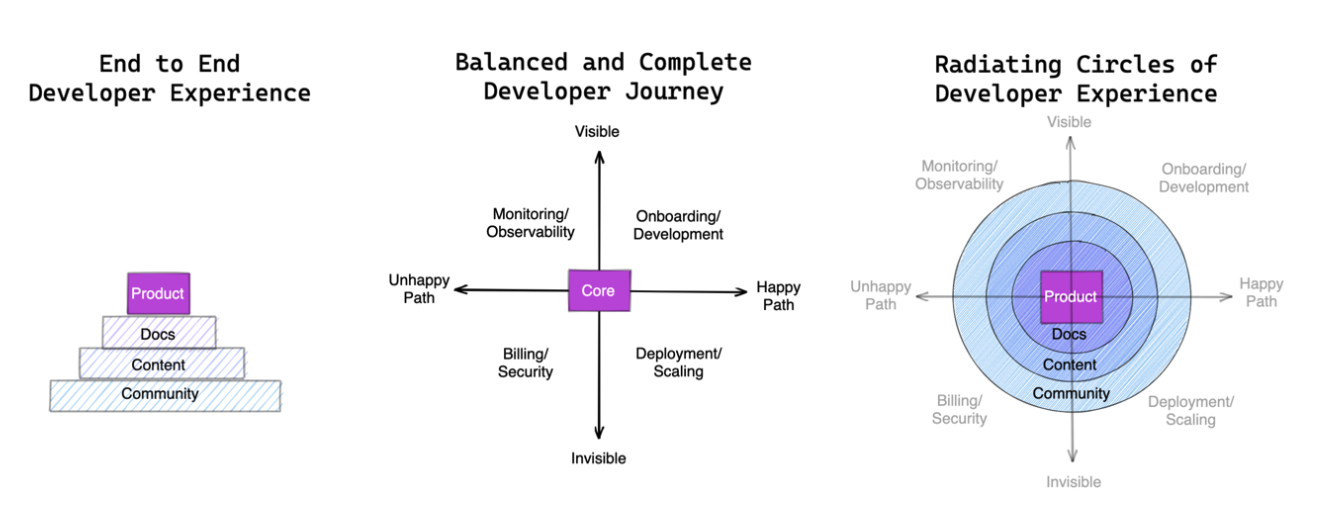
Adjust to taste . 4 layers is merely the simplest I can make it. This concentric circle model just represents an idealized proportion of how much of each type of DX effort you might want; based on your situation, you might want more of one thing and less of another.
For example, Snowflake and Stripe did not bother having fulltime developer relations for their first 5-7 years of existence, whereas SEO-driven SaaS apps should overindex on content rather than community.
Product DX
Scaffolding/Hello World
API Design
Error messages (that don't make me think )
UI affordances/validation/visual feedback
Dashboard/Admin UI
Auxiliary Devtools, CLIs/Utilities, Editor Integrations
Speed, speed, speed. Speed is so important it is its own feature.
Docs DX
API Reference
Tutorials, Guides, Recipes (shared with Content)
FAQ and Glossary/Conceptual Explanations
Debugging guide ("Common Errors & How To Fix Them")
Readme's
Versioning/Migration
Search experience
Information Architecture
Content DX
Blogposts
Tutorials, Guides, Recipes (shared with Docs)
Demos/Workshops
Shortform Videos
Longform Videos (including livestream footage and external talks)
Community DX ( More on [ Community Heat](https://www.swyx.io/community-heat) in a previous post)
Hot Community
Chat (Slack/Discord)
Livestream/Meetups/Company Conference
Social Media (Twitter/LinkedIn/Reddit/etc)
Cold Community
Forum posting
Newsletter
Quarter/Annual Roundup or Changelog or Survey
You can pretty much turn some version of this list into a DX Architecture checklist for every launch/update you do.
see Ken Auchenberg's version of this list [ here](https://kenneth.io/post/developer-experience-infrastructure-dxi)
## The Feature Map: Completeness and Sequencing
The other Developer Experience ball that often gets dropped is solely focusing on the happy/beginner path .
A lot of developer advocates spend their time only talking about their company's free tier, and doing "Hello World" ad infinitum. This comes out of the standard view of DevRel as a pure top-of-funnel function, leaving users with a sharp learning curve the moment they need to wander off the paved road.
The central argument of Developer Exception Engineering is that responsible DX should at least briefly* prepare the user for the less glamorous, unhappy path.
I actually hesitate to call it "less glamorous" in terms of public visibility, because everyone who gets as far as the unhappy path are your serious users - in other words, the people actually paying your bills! For sure this function should be shared with solutions/success/support teams. No one function can really be responsible for all the things, but empathy means understanding that the user will eventually face issues and preparing them for it.
My second realisation about designing a "complete" developer experience is that everyone should have the same mental map of what the company's features even are . Everyone has their favorite toy feature, but especially in mature projects, it's common to have so many features that not everyone even knows all the features or are aligned on what the company wants to offer for each user persona. It’s like a world map - it’s a matter of opinion where to draw national borders, but a matter of fact where the actual landmasses are.
The solution for this is Feature Mapping , which I will cover in a future blogpost, but you can see how we applied it at Temporal in this talk . The TL;DR is you want to pick the two most important axes that circumscribe your developer experience and make sure that all your users go through them, or can at least easily find them when they need to. Tagging everything and clustering them:
Produces this simplified chart:
Must it be a 2x2? No - make it a pentagon, or sextagon , dodecahedron, or whatever you want. Just remember that every extra dimension makes it that much harder to remember and therefore less likely to stick.
Simplicity is a feature.
Finally, sequencing , or providing an opinionated path through your feature map, helps put your developer experience on rails rather than making every branching point a tiring choose-your-own-adventure.
Examples: Feature Mapping Axes
Pick from two DX axes that your users care most about:
Happy path vs Unhappy path
Developer vs Operator
User-facing vs Behind-the-scenes
Positive vs Negative Engineering
Proprietary cloud vs Open source
Getting started vs Production (Debugging/Testing/Monitoring/Upgrading/Scaling)
Core architecture vs Plugin development
Basically, there's always some version of "eat your vegetables" part of your developer experience that is consistently overlooked, and some version of "small" that looks very different when it is "big". Figure out what they are and make it a habit to give the overlooked part as much care as the flashier parts of your DX. Your users will appreciate it - and be more successful as a result.
Putting Both Together
Having gone through the exercise of the Metalanguage Stack and the Feature Map, you can simply paste one atop the other, and evaluate your current experience against your ideal:
This is basically a two dimensional checklist that helps you find developer experience gaps and get everyone aligned on what matters to the company and to users!
You might be wondering how to apply this, so here's a 30 minute exercise:
Take a devtool company you know well
Ask what top 4 things serious users should know on the first encounter, and when they adopt for production
Taking a critical, unsentimental look at each of their community, content, docs, and product:
DX starts from the core
Why this concept is known as "Radiating" Circles is that DX Architecture starts from inside-out. The best docs and devrel in the world don't matter if the product is fundamentally broken. All you'll have is a leaky bucket - People will try you out and then leave right away with a poor first impression.
So it makes sense that your DX efforts should adjust to maturity : The earlier the product, the more that inner circles should be emphasized over outer ones.
If you have a new product/feature launch coming soon, focus on the product first (API design, error messages, visual feedback, etc), then the docs, then the content, and so on, in that order. Overweighting outer circles when the inner circles aren't complete will make the experience feel lacking.
In practice, things are never that sequential, so this is more of a guideline of where to spend time. Start as close to the product as possible, then work your way outward, doubling back whenever you have a new product launch or discover some new insight about your user's needs.
Further Reading
The talk version of this blogpost has more context and explanations on some of the design choices behind these mental models:
Other relevant org chart and design thinking posts:
Acknowledgements - thanks to Lee Robinson and Thomas Schranz for reviewing early drafts as well as Pauline Narvas and Mike Nikles for giving the original inspiration to write this up!